.svg)
Best Esports Management Software in 2026: 10 Tools for Venues, Tournaments and Leagues

Running a gaming venue is harder than any feature list makes it look. We know this firsthand: SENET has spent eight years building software for gaming centers and esports venues, now runs in more than 90 countries, and collects operator feedback every day. One thing that feedback makes clear is that choosing software is harder than it should be.
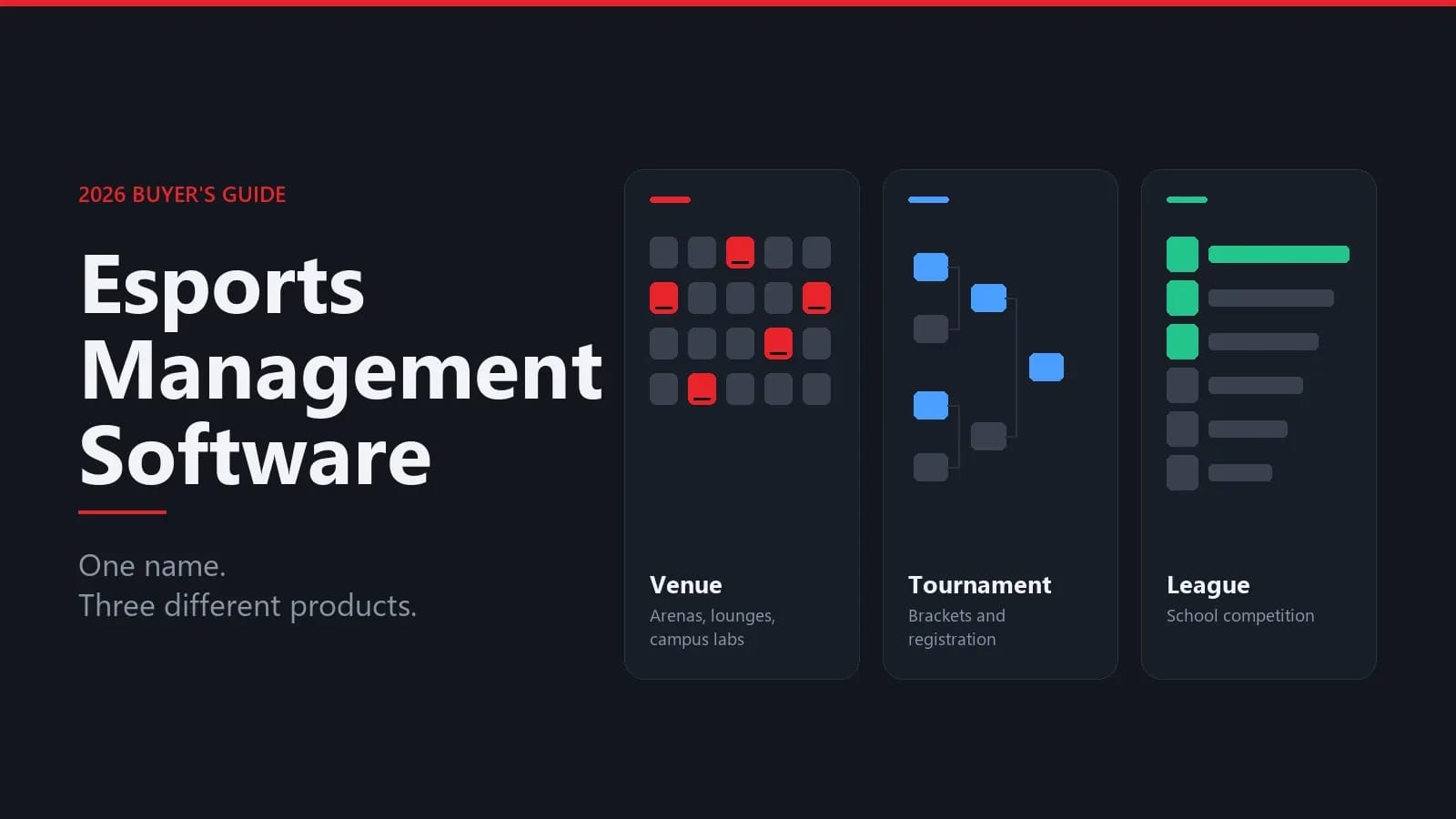
Esports management software is one name for four different product categories.
A gaming venue needs software to control PCs and consoles, sessions, billing, games and customer accounts. A tournament organizer needs brackets, registration, scheduling and match reporting. A school running an esports lab needs access to an organized league as well as software to manage the lab itself. A professional team has another set of requirements again.
You can’t swap one for another.
That’s why this guide doesn’t rank ten unrelated tools from first to last. Instead, we compare them by the job they are designed to do, so you can quickly narrow the list to the products that actually fit your operation.
TL;DR: If you run a physical gaming space, start with SENET, ggCircuit, SmartLaunch or iCafeCloud. If your main job is organizing competition, compare Toornament, Battlefy, start.gg, Challonge and LeagueSpot. If you are a school primarily looking to join structured scholastic competition, PlayVS belongs in a different category again. Many organizations ultimately use more than one of these tools.
What does esports management software actually mean?
There is no single esports management system that covers every part of the industry equally well.
In practice, most esports management tools fall into three main product categories:
What you run | What you actually need | Products to compare |
|---|---|---|
A physical gaming venue, LAN center or campus esports lab | Device, session, billing and customer management | SENET, ggCircuit, SmartLaunch, iCafeCloud |
Tournaments, leagues or competitive events | Registration, brackets, scheduling and match operations | Toornament, Battlefy, start.gg, Challonge, LeagueSpot |
A scholastic esports program looking for organized competition | Access to a school competition ecosystem | PlayVS |
A team or esports organization without its own facility | Roster, scrim, schedule and communication tools | Usually a combination of general team tools rather than a dedicated esports platform |
A bracket platform may be excellent esports software while doing nothing to control the PCs on your floor. A venue platform may automate your entire gaming space while deliberately leaving large tournament brackets to a specialized service.
Best esports management tools for running gaming centers
Here is the shortlist we would use for a venue comparison in 2026.
Product | Best for | Deployment | PCs & consoles | Tournament support | Starting from |
SENET | Full operational management of modern gaming venues and campus labs | Cloud management with local venue components | PCs + consoles | Pair with a dedicated bracket platform for larger events | $3 / device / month |
ggCircuit / ggLeap | Established commercial gaming venues that want a cloud-first administration layer | Cloud admin + venue clients | PCs + consoles | Tournament integration available | $7 / PC / month |
SmartLaunch | Operators that prefer an established venue-management stack with built-in tournament functions | Venue server/client architecture | PCs + consoles | Yes | $7 / PC / month |
iCafeCloud | Cost-conscious PC-heavy venues with strong game and license-management needs | Cloud panel + local server components | PCs + consoles | Not its primary function | $2.50 / PC / month |
Diskless boot is priced differently across the four: SENET includes SENET Boot in its Premium package, SmartLaunch moves SmartDisk into a higher tier, iCafeCloud sells a CCBoot bundle, and ggCircuit’s ggRock is a separate product.
SENET — best for managing the complete physical venue

Best for: esports arenas, gaming lounges, university esports labs and multi-zone spaces that need to manage PCs and consoles, player sessions, billing, content and customer activity from one system.
Not the right tool if: your primary business is running online tournaments or a professional esports team with no physical gaming infrastructure.
SENET is built around the day-to-day operation of a gaming space.
From the admin side, staff can see PCs and consoles on an interactive venue map, monitor active sessions, manage users, apply rates and passes and control devices remotely. Owners can use the same platform for reporting, revenue tracking and multi-location operations.
On the player side, SENET provides personal accounts, a game library, reservations, self-service payments and loyalty features. The platform also connects gaming time with food, drinks and other products sold through the venue rather than treating gameplay and POS activity as completely separate workflows.
Game and content management.
SENET can centralize the available game library and, depending on the selected package, automate game updates and use SENET Boot for diskless or hybrid environments. SENET Boot is included in the Premium package.
Console zones can also be brought into the same operating workflow. SENET supports session tracking and unified management for PCs and consoles, including PlayStation, Xbox, Nintendo and other HDMI-based setups.
That combination makes SENET particularly useful when the main problem is running the facility itself.
If you hold occasional competitions, the same venue infrastructure still handles the seats, accounts, payments and play time. For more complex brackets or large competitive circuits.
See how SENET handles esports venue management, or review current SENET pricing.
ggCircuit (formerly ggLeap) — strong alternative for established venues

Best for: commercial gaming venues that want mature player/session management and are comfortable building their stack around the ggCircuit ecosystem.
Not the right tool if: you only need a simple tournament bracket or do not operate gaming hardware yourself.
ggLeap is the venue-management component of the broader ggCircuit product ecosystem.
Its core features cover gaming machines, player accounts, bookings, offers, loyalty mechanics and venue operations. ggCircuit also offers ggRock for imaging and PC management.
Competition features are available through tournament integrations, allowing venues to connect tournaments and leagues with their gaming-center operations rather than manage everything manually in a separate process.
The decision between SENET and ggCircuit comes down less to whether either product belongs in the category and more to how their workflows, deployment model, console handling, technical stack and commercial terms fit your specific venue.
One structural difference is worth pricing out before you decide. ggLeap is a single flat rate per PC with the feature set included, and diskless boot sits in a separate product, ggRock, rather than in the platform itself. If you want every capability from day one, a flat rate keeps the maths simple. If you run a twenty-seat room that needs session control, billing and not much else, a tiered platform that starts lower can come in at half the monthly cost, and diskless becomes a second buying decision instead of a plan you upgrade into.
SmartLaunch — established venue management with tournament tools

Best for: venues that want traditional gaming-center operations and tournament features inside the same product family.
Not the right tool if: your operation is primarily a large online league or tournament circuit rather than a physical venue.
SmartLaunch is one of the longest-established products in this category.
Its venue-management platform combines station and session control, time billing, pricing, game management, loyalty and financial workflows. It also supports console management and provides tournament tools.
SmartLaunch also offers SmartDisk for centralized game deployment and updates.
Pricing is unusually transparent for this category. At the time of verification, the standard plan starts at $7 per PC per month, a premium-support tier at $12, and the plan combining premium support with SmartDisk at $15 per PC per month.
SmartLaunch deserves a place on any shortlist where tournament features inside the venue platform itself are a priority.
iCafeCloud — strong on game updates, licenses and straightforward pricing

Best for: PC-heavy venues that prioritize session billing, game management, license sharing and relatively simple per-device pricing.
Not the right tool if: you need a sophisticated competition platform or a dedicated system for running a large tournament ecosystem.
iCafeCloud combines session billing, member management, reservations, reporting, game updates and license management in one platform.
One of its more distinctive features is shared game-license management. Venue-owned accounts can be placed into a pool and assigned to players for the duration of a session rather than being permanently tied to individual machines.
It also supports console time control alongside PCs and can be paired with CCBoot for diskless deployment.
Pricing is another reason operators may shortlist it. As of October 2026, iCafeCloud lists a monthly price of $2.50 per PC, or $2.00 per PC per month when paid annually. The iCafeCloud + CCBoot bundle is priced separately.
That makes it an interesting option for operators who put game distribution, PC operations and predictable per-seat cost ahead of deeper customer-experience or competition-management features.
If your business model extends beyond esports-focused venues, we have a separate comparison of internet cafe software.
Tournament and bracket platforms
Tournament software solves a different problem.
These platforms are designed around competitors rather than workstations. Their core objects are players, teams, registrations, brackets, matches, scores, standings and event schedules.
If you already have software controlling the physical venue, adding a tournament platform is usually more sensible than replacing the venue system.
Toornament — best for scalable competition ecosystems

Toornament is designed for organizers who need more than a basic bracket generator.
It covers registrations, participant management, check-in, match reporting and multiple competition structures, and extends into circuits, rankings, branded tournament sites and platform/API use cases.
That gives it a wide range. A community organizer can use it for individual events, while larger organizers, brands and publishers can build more complex competition ecosystems around it.
Choose Toornament when: the competitive structure itself is the difficult part of your operation.
Battlefy — strong for organizer-led esports tournaments

Battlefy is a dedicated tournament-management platform rather than a venue-management system.
Organizers can configure registrations, participants, check-ins, score reporting and different competition formats. Battlefy supports common formats including single and double elimination, round robin and Swiss.
Organizations can also maintain their own tournament presence and assign staff to help run competitions.
This makes Battlefy a sensible choice for esports communities, brands and tournament operators that need an established workflow for running events but don’t need the software to manage the computers those matches happen on.
start.gg — best known for community-driven competitive events

start.gg grew out of the competitive gaming community and remains particularly recognizable in tournament scenes where registration, brackets and event logistics all need to sit together.
Organizers can manage registration, attendees, teams, bracket setup, seeding, pools, schedules, stations, streams and match reporting through the platform.
For larger in-person competitive events, the ability to connect brackets with registration, venue passes, stations and streams is particularly useful.
start.gg is a stronger fit when you are running the event than when you’re running the gaming facility.
A gaming lounge hosting a weekend competition could easily need both: its usual venue-management platform to operate the room, and start.gg to operate the competition taking place inside it.
Challonge — straightforward bracket management with a low barrier to entry

Challonge is one of the most familiar names in online bracket management.
It supports single elimination, double elimination, round robin, Swiss, free-for-all, leaderboard and multi-stage formats, as well as participant registration and community features.
Its main advantage is accessibility.
You don’t necessarily need a complex esports infrastructure to create and manage a competition, and organizers can start on a free plan. The Standard tier costs nothing and carries advertising; Premier is $6.99 per month billed yearly, which is the tier most venues and brands end up on once they want the events to look like their own.
That makes Challonge especially useful for local tournaments, recurring community competitions and venues that already have their operational software but need a recognizable bracket layer.
For sophisticated publisher ecosystems or deeply branded leagues, a platform such as Toornament or LeagueSpot may offer a better fit. For straightforward bracket management, Challonge remains difficult to ignore.
LeagueSpot — branded tournament and league infrastructure

LeagueSpot sits further toward structured leagues and managed competitive ecosystems than a simple bracket generator.
The platform supports custom-branded tournaments and leagues, scheduling, organization management and competition across multiple game titles. It also emphasizes security and controlled environments, including programs involving younger participants.
That makes it particularly relevant to organizations that want the competitive experience to operate under their own brand rather than simply creating a public bracket.
There is also an important ownership update that older comparison articles may miss: PlayVS acquired LeagueSpot on April 9, 2026.
LeagueSpot still belongs in this tournament section because that is what the product itself does. Its ownership doesn’t turn it into the same product as PlayVS.
If you are building a serious tournament or league operation, that distinction matters.
For a practical walkthrough of the operational side of competition, see our guide on how to host an esports tournament.
Scholastic and collegiate league platforms are a different purchase
A school esports program exposes another source of confusion around esports management software.
Schools may need two completely different systems:
- software for running the esports lab
- a platform or organization through which students compete against other schools.
Those are separate jobs.
PlayVS — best understood as a scholastic competition platform

PlayVS belongs on this list because schools comparing esports management platforms will encounter it almost immediately.
But it shouldn’t be evaluated as if it were SENET, ggCircuit or SmartLaunch.
You are primarily buying access to a competition ecosystem, not a licence for software that runs your gaming room.
PlayVS organizes scholastic and collegiate competition and provides the platform used by schools, coaches and students participating in that ecosystem.
The company has also consolidated several major education-focused esports properties. It acquired Generation Esports and Playfly College Esports in April 2025, followed by LeagueSpot in April 2026.
For the 2026–27 school year, PlayVS returned to a paid model for middle- and high-school competition. Its published fee is $595 per year for high schools and $495 per year for middle schools, with lower early-payment rates that applied before August 7, 2026.
That’s why comparing PlayVS directly against venue-management software produces a misleading result.
A school may realistically use both.
PlayVS can provide the league and competition structure. The software running the lab still has to manage PCs, access, sessions, games, updates and potentially student identity.
For more on that side of the stack, see our guides to esports software for schools, campus esports programs and building an esports lab.
How to choose esports management software
Instead of comparing dozens of features, work through five questions.
1. Do you operate the physical gaming space?
If yes, begin with the venue category: SENET, ggCircuit, SmartLaunch or iCafeCloud.
You need the software to understand seats, devices, sessions, time and payments before tournament features become relevant.
If no, a venue-management system may be unnecessary.
2. Are you managing PCs only, or PCs and consoles?
Mixed environments narrow the shortlist quickly.
Consoles are a minority case, which is exactly why vendors differ so much here: 23.6% of the venues we surveyed ran a console zone.
Console zones should ideally follow the same basic commercial rules as PC zones: session duration, pricing, customer accounts, bookings and reporting.
Avoid treating console billing as a completely separate manual process if consoles are a meaningful part of the venue.
3. How often do you run tournaments?
An occasional local event doesn’t necessarily justify choosing your entire management stack around brackets.
A venue can use its regular operating platform for devices, sessions and payments and add Challonge, start.gg, Battlefy or another tournament tool when an event requires it.
If tournaments are the business rather than an occasional event, reverse the logic and begin with the competition platforms.
4. Is this a commercial venue or an educational environment?
Schools and universities usually introduce another set of requirements: controlled access, user roles, centralized administration, student identity and potentially SSO.
District technology coordinators should therefore evaluate esports software as part of their device and identity infrastructure, not just as an app used by the esports coach.
An LMS integration and an SSO integration are also not the same thing. If either is mandatory, verify the exact integration with the vendor rather than assuming a general “education” feature covers it.
Our guide to features schools should look for goes deeper into that use case.
5. Who will administer the platform every day?
A feature only creates value if staff can actually operate it.
A local venue may have an administrator sitting at reception. A university may need central IT to configure policies while student staff handle normal sessions. A tournament may have dozens of volunteers with separate permissions.
During a trial or demo, test the everyday workflows rather than only the owner dashboard:
How does an employee start a session? What happens when a customer changes seats? Who can change prices? How are refunds recorded? How do you update fifty machines? How does a tournament admin correct a result?
Those workflows expose the real differences between products much faster than a feature checklist.
Can one esports management platform do everything?
Usually not — and trying to force one platform to cover every category can create a worse setup.
A typical commercial venue might use:
venue management platform → tournament platform when needed
A school program may need:
lab management → identity/access controls → scholastic league platform
A large tournament operator may need:
competition platform → ticketing/payment tools → communication → broadcast infrastructure
Those systems can overlap, but overlap doesn’t make one a replacement for another.
SmartLaunch, for example, includes tournament features as part of a venue platform. ggCircuit integrates tournament tools. Challonge can assign matches to stations. None of those facts means all three products solve the same overall problem.

If the main job is running a physical gaming venue, you can start a SENET trial and test the workflow on your own setup.
How we picked the 10 esports management tools in this guide
This is a curated comparison, not a review-score ranking.
SENET is our product, so there is an obvious commercial interest. Rather than hide that fact, we use three rules to keep the comparison useful.
First, every product included here must actually perform an esports-management job. We excluded voice-chat apps, standalone retail POS products, betting platforms and unrelated sports software that sometimes appear in broad software directories simply because they contain gaming-related keywords.
Second, each product appears in the category that reflects its primary purpose. A venue platform with tournament features is still a venue platform. A tournament platform owned by a scholastic league company is still a tournament platform.
Third, we don’t claim to have hands-on experience with every competitor. Product capabilities and pricing were checked against publicly available vendor information and documentation, most recently in October 2026.