.svg)

Introduction
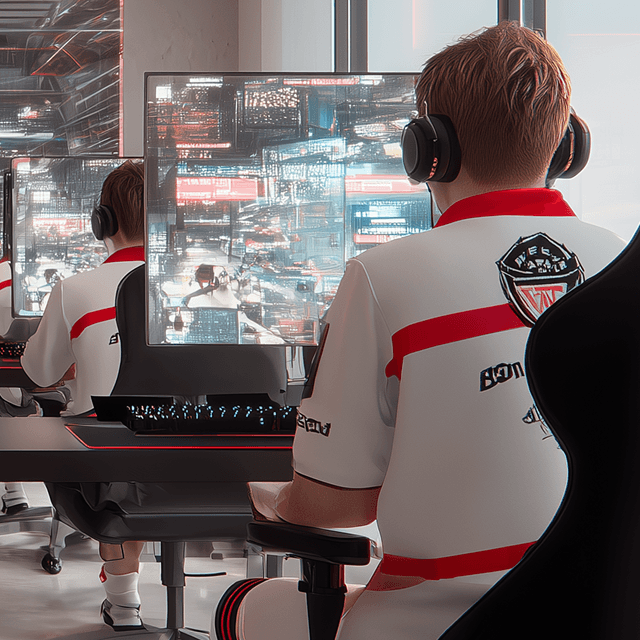
Today, esports is one of the most popular topics for discussion and investment.
Major global brands are competing for sponsorship deals with esports teams. Gaming centers are opening dedicated streaming rooms, training areas, and even full-scale 5v5 esports arenas.
In sports bars and even regular cafés, it’s becoming increasingly common to see live broadcasts of esports tournaments. Esports is growing every month and becoming more mainstream.
But where did it all begin? And how does such a massive ecosystem actually work?
Where is the money in esports? Who are esports players, and how are teams structured? Can esports be used as a marketing tool to attract new customers?
We’ll break all of this down in this article.
What Is Esports?
Simply put, esports is competitive gaming — matches between two or more players or teams in video games.
Competitions can be:
- individual
- team-based
Just like in traditional sports, but instead of physical performance, players showcase their skills through gameplay.
“Esports (also known as electronic sports or competitive gaming) is a form of competition using video games.”
At first glance, calling esports a “sport” might seem odd. However, competing at a high level requires serious preparation — both mental and physical.
That’s why esports has evolved from a hobby into a structured and competitive global industry.
Today, there are over 200,000 video games (and over a million if you include indie titles). However, only about 8–10 games are considered true esports disciplines.
Key Facts About Esports
- Esports is among the top 10 most popular sports worldwide
- The industry is growing at approximately 25% annually
- The global esports audience exceeds 600 million people
- China is the largest esports market in the world
- The total market value of esports exceeds $1 billion
These numbers highlight the scale and importance of esports as both an entertainment industry and a business ecosystem.

The History of Esports
There is a lot of information about the origins of esports, but many sources trace its early development back to 1980 in Japan.
That year, Taito Corporation released the game Space Invaders and organized a large-scale tournament.
Arcade machines featuring the game were placed across Japan — in cafés, stores, malls, and even on the streets.
- tens of thousands of arcade machines were produced
- more than 50,000 players participated
The key innovation was the leaderboard system — players could see high scores and compete to beat them.
This competitive element sparked a global trend and laid the foundation for modern esports.
After that, many games began incorporating ranking systems and competitive mechanics.
The Evolution of Esports
For many years, esports developed slowly and was mainly used as a marketing tool.
Game publishers would organize tournaments to promote new releases — attracting players and generating hype.
This strategy still exists today, but esports has grown far beyond it.
A major turning point came with the rise of gaming centers. These venues became the first places where structured tournaments and communities were built.
Later, professional tournament organizers such as ESL and DreamHack took over.
Today, gaming centers are once again becoming important hubs for esports, with:
- dedicated 5v5 arenas
- viewing zones
- training rooms
Esports Today
Esports has reached a level where millions of people watch tournaments worldwide.
One of the most popular esports titles is League of Legends.
In 2022, its World Championship reached nearly 142 million viewers.
Viewership is critical because it drives:
- sponsorship deals
- media rights
- advertising revenue
Who Is an Esports Player?
Not every gamer is an esports player.
A professional esports athlete must have:
- analytical and strategic thinking
- fast reaction speed
- teamwork and communication skills
- ability to process information
- adaptability
- mental resilience
Top players earn income from:
- tournament prize pools
- salaries
- sponsorships
- personal content (streaming, social media)
One of the highest-earning players is Johan Sundstein, with over $7 million in prize money.
What Is an Esports Organization?
An esports organization is a full-scale business.
According to Forbes, one of the most valuable esports organizations is Team SoloMid, valued at over $400 million.
These organizations include multiple roles:
- managers
- analysts
- coaches
- players
- marketers
- designers
- content creators
- psychologists
- commentators
Esports is not just about players — it’s an entire industry of professionals.
Gaming Centers as Part of the Ecosystem
Gaming centers have always been part of the esports ecosystem.
They serve as:
- training grounds for players
- venues for local tournaments
- community hubs
In regions like Latin America, it’s common to invite professional players to host training sessions and events.
Governments and institutions also collaborate with gaming centers to promote esports.

Where Is the Money in Esports?
Many assume the money comes from prize pools.
While some tournaments exceed $40 million, most of that money goes to players — not teams or organizers.
The real revenue comes from:
- sponsorships
- media rights
- streaming platforms
- merchandise and ticket sales
Sponsorships remain the primary source of income.
The Global Esports Ecosystem
The esports ecosystem includes:
- game developers
- tournament organizers
- streaming platforms
- esports teams
- agencies
- gaming centers
- online tournament platforms
- media
- support staff
Each part plays a role in sustaining the industry.
Conclusion
Esports is a complex ecosystem where every component works together.
What once seemed like a niche hobby has become a global industry with new opportunities emerging every year.
In the future, we may see:
- VR esports
- AR competitions
- new game genres
Gaming centers will likely play an even bigger role in this evolution.
Facts and Myths About Esports
- The first tournament took place in 1972 at Stanford University — the winner received a Rolling Stone subscription ✔️
- 45% of gamers in the U.S. are women ✔️
- Anti-doping systems in esports exist ❌ (not yet, but likely in the future)
- Esports was once primarily a marketing tool ✔️
- Space Invaders caused a coin shortage in Japan ❌ (coincidence)
- League of Legends hosts the biggest tournaments ✔️
- Average revenue per fan: $15 in traditional sports vs. up to $5 in esports ✔️
- Dota 2 has the largest total prize pool ✔️
- Free Fire World Series 2021 reached 5.4 million peak viewers ✔️
- 80% of Americans are not engaged with esports ✔️